Why the AI Data Center Boom Strains Your Power and Water
AI is driving a massive jump in data center power demand, pushing operators toward new gas and nuclear plants and into rural towns. Here are the numbers and what they mean for neighbors.
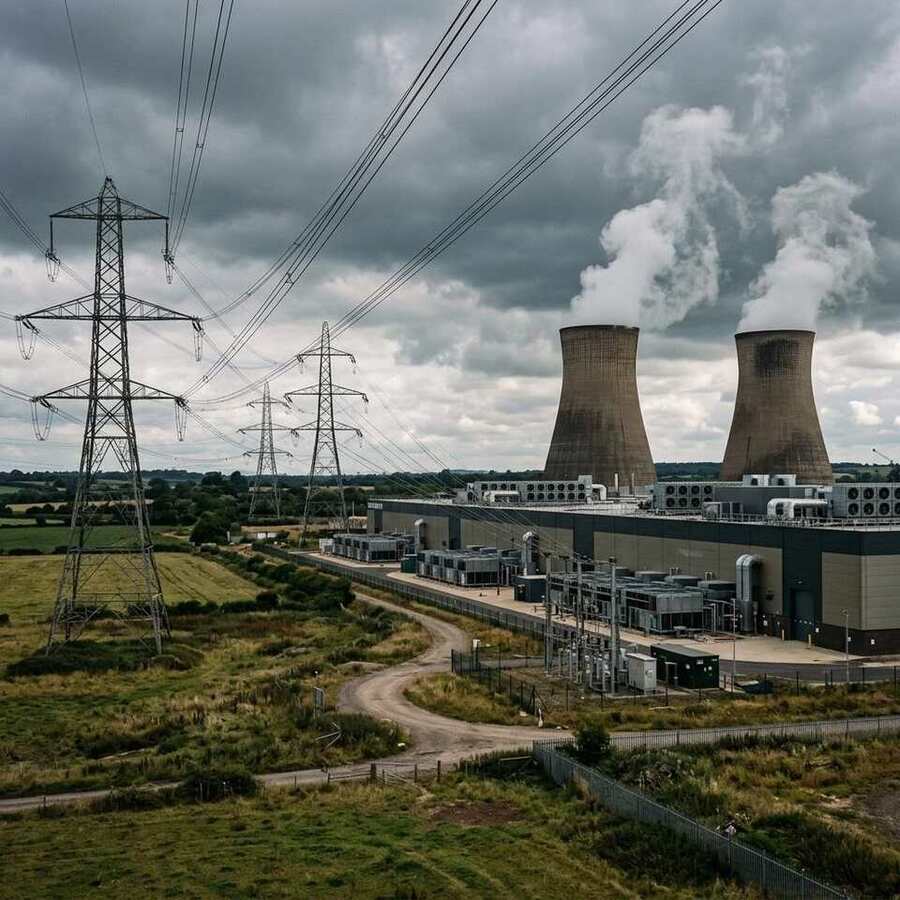
The race to build artificial intelligence is really a race to build power plants. AI data centers use staggering amounts of electricity and water, and the demand is climbing so fast that operators are restarting nuclear plants and pushing into rural communities that never asked for them. Here are the numbers, and what they mean if one is headed for your area.
Key takeaways
- Electricity demand for AI data centers is projected to grow about 160 percent over 2023 levels by 2030, according to a Goldman Sachs Research estimate.
- A single large data center campus can use at least 1 gigawatt (GW) of power, roughly the amount needed to power 750,000 homes or a major city.
- Some leading AI companies anticipate needing about 5 GW of power for their operations.
- Analysts estimated roughly 47 GW of new generating capacity would be needed through 2030, projected at about 60 percent natural gas and 40 percent renewable, requiring on the order of 50 billion dollars in capital.
- In September 2024, Constellation Energy announced plans to reopen the Three Mile Island nuclear facility under a 20-year agreement to power data centers, with operations targeted for 2028.
- The federal government created an interagency Task Force on AI Datacenter Infrastructure in September 2024, and Congress considered the Department of Energy AI Act (HR 9671 in the House and S 4664 in the Senate).
The demand curve is the story
The core problem is speed. Goldman Sachs Research estimated that AI would push data center electricity demand up about 160 percent over 2023 levels by 2030. That kind of growth does not fit quietly into the existing grid. It requires new generation, new transmission, and new places to put enormous buildings.
What a gigawatt means
Numbers like "1 gigawatt" are hard to picture, so here is a comparison drawn from the reporting. A large data center campus can draw at least 1 GW, which is roughly enough electricity for 750,000 homes. Some AI companies expect to need around 5 GW each. Cumulatively, analysts estimated about 47 GW of new capacity would be needed through 2030, at an estimated cost near 50 billion dollars.
Where the power comes from
That new capacity has to come from somewhere. The projected mix was roughly 60 percent natural gas and 40 percent renewable sources. In one high-profile example, Constellation Energy announced in September 2024 that it would reopen Three Mile Island under a 20-year agreement to supply a data center buildout, targeting 2028. New gas plants and restarted nuclear units are not distant abstractions to the towns that host them.
Why this lands on rural communities
Because power and land are the constraints, operators increasingly look to rural areas that have available capacity and open ground. That is how a community with no history of heavy industry can suddenly face a facility that uses as much electricity as a city, along with the cooling water, backup generators, and transmission lines that come with it.
What this means for you
The scale explains the harm. Enormous power demand raises the question of who pays for the grid upgrades, and too often the answer has been ordinary ratepayers. Massive cooling needs put pressure on local water and wells. New generation and backup generators bring air emissions and noise. If a project of this size is proposed near you, treat the announcement as the moment to start paying attention, ask who will pay for the power, where the water will come from, and what the facility will sound and smell like at 2 a.m.
Sources
- Goldman Sachs Research, cited for the estimate that AI data center power demand would grow about 160 percent over 2023 levels by 2030 and for related capacity and cost figures.
- Constellation Energy, company announcement regarding the Three Mile Island restart (September 2024).
- The White House, for the interagency Task Force on AI Datacenter Infrastructure (announced September 2024).
- U.S. Congress, Department of Energy AI Act, HR 9671 (House) and S 4664 (Senate).
- Reporting by DLA Piper, "Leaders work to align energy infrastructure with growing demand for AI data centers" (AI Outlook, 2024).
Editorial note: the power and cost figures above are third-party projections from 2024 and will change. Attach an "as of" date to each figure and confirm it against the original source before publishing.
Related reading
- New York's proposed data center moratorium, explained
- Water and wells: what a data center can do to your groundwater
- Air and emissions: backup generators and the air your family breathes
Attorney Advertising. This article is general information, not legal advice, and does not create an attorney-client relationship. If a data center is affecting your home, contact us for a free, confidential case review.
Is a data center affecting your home or community?
Tell us what you're experiencing. A case review is free, confidential, and comes with no obligation. If we can help, we'll tell you. If we can't, we'll point you in the right direction.